
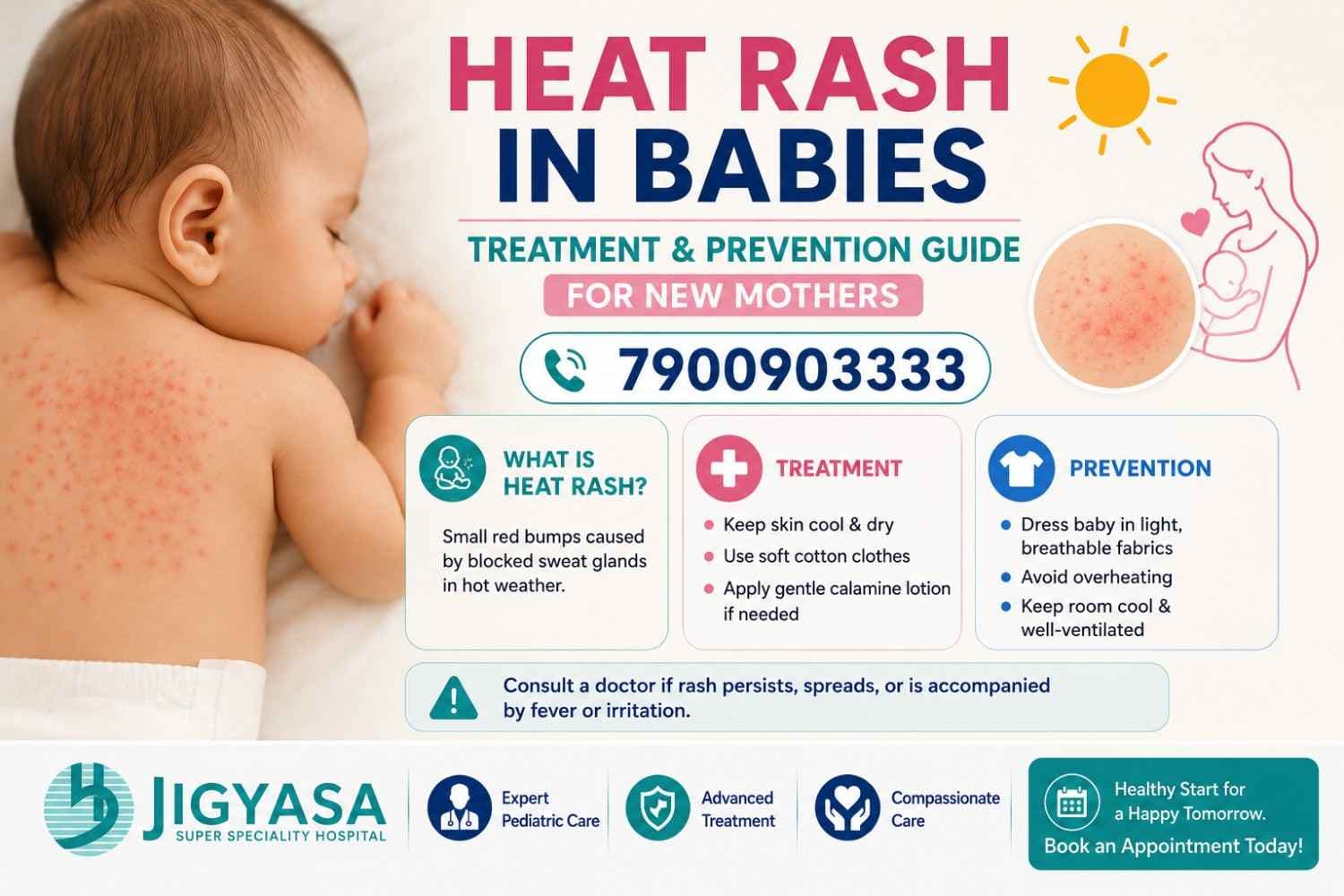
Heat Rash in Babies — Treatment & Prevention Guide for New Mothers
Baby Heat Rash in UP Summer? Causes, Types, Home Treatment & When to See a Doctor — A Complete Guide from Jigyasa Hospital Moradabad (2026)
Heat rash — known as prickly heat or ghamori in Hindi — is one of the most common skin conditions affecting babies and young children during summer months in India. It occurs when sweat glands become blocked, trapping perspiration beneath the skin instead of allowing it to evaporate. The result is a rash of tiny red or pink bumps, sometimes with clear or white fluid-filled blisters, typically appearing in skin folds and areas covered by clothing. Babies are far more vulnerable than adults because their sweat glands are still developing and cannot manage heat as efficiently. In the intense heat of Uttar Pradesh summers — with temperatures regularly exceeding 42°C to 46°C in cities like Moradabad — heat rash in babies is one of the leading reasons parents bring their infants to our Paediatrics OPD at Jigyasa Hospital. The good news: heat rash is rarely dangerous and almost always resolves with the right care at home — but knowing what to do, and crucially when to seek medical help, is every new mother's essential summer knowledge.
Why Babies Are So Prone to Heat Rash
A newborn's eccrine (sweat) glands are not fully mature and block more easily under heat stress. Babies also have a higher skin surface-to-body-weight ratio, which means they absorb environmental heat more rapidly than adults, and they depend entirely on caregivers to keep them cool — they cannot adjust their own thermal comfort.
Tight or synthetic clothing traps heat and moisture directly against delicate skin. Skin folds — the neck, underarms, groin, and behind the knees — are naturally warm and moist, creating ideal conditions for sweat gland blockage. Overdressing is a very common cultural habit in India; many new mothers and grandmothers dress babies in multiple layers even in peak summer heat.
Other contributing factors include heavy oil massage before bathing (which can clog pores in summer), prolonged skin-to-skin contact in warm conditions, and non-breathable synthetic mattress covers and thick bedding that trap heat under the baby.
Types of Heat Rash in Babies — Know What You Are Seeing
Miliaria Crystallina is the mildest form — tiny, clear or white, fluid-filled blisters that look like dewdrops on the skin. They usually appear on the face, neck, and upper chest, are generally painless and itch-free, and resolve quickly with cooling as they affect only the top layer of skin.
Miliaria Rubra is the most common form — the classic ghamori. Small red or pink raised bumps appear in the neck folds, chest, back, underarms, groin, and inner elbows and knees, causing itching, a prickling sensation, and mild discomfort. Babies may seem irritable and scratch-prone. This form affects deeper skin layers than Crystallina and requires active management.
Miliaria Pustulosa occurs when Miliaria Rubra bumps become infected — the fluid inside turns cloudy or yellowish. This requires medical evaluation to rule out bacterial skin infection. Miliaria Profunda is the rarest and most severe form — flesh-coloured, firm bumps primarily on the trunk and limbs, with reduced sweating as the sweat glands are deeply blocked. This form requires paediatric medical attention.
Where Heat Rash Appears Most Commonly in Babies
The neck folds are the most common site — skin here is almost constantly in contact and moist. Underarms are warm and enclosed, causing sweat to accumulate quickly. The groin and nappy area are covered, moist, and warm, and heat rash here is often confused with nappy rash. The back and chest are affected particularly when the baby lies on a warm surface or wears tight clothing.
Behind the knees and elbows, skin-on-skin contact creates localised hotspots. The forehead and scalp are also vulnerable, especially if the baby wears a cap outdoors.
Home Treatment for Baby Heat Rash — Step by Step
Step 1 — Cool the baby immediately. Move the baby to a cool, well-ventilated room — ideally air-conditioned or with a gentle fan circulating air indirectly. Remove all unnecessary clothing and let as much skin breathe as possible. For older infants, a lukewarm (not cold) bath provides rapid relief. After bathing, pat the skin completely dry — gently pat every fold and crease — and allow 10 to 15 minutes of air-drying time before dressing.
Step 2 — Apply the right topicals. Calamine lotion is the safest and most effective topical for baby heat rash — it cools the skin, reduces itching, and gently dries out the rash. Pure unfragranced aloe vera gel is a natural anti-inflammatory that soothes and cools rash areas. Neem-based dusting powder has mild antibacterial and cooling properties. Avoid regular talcum powder (fine particles can be inhaled), petroleum jelly and adult creams (which occlude the skin and worsen blocked glands), perfumed lotions, and heavy oil massage on rash areas in summer.
Step 3 — Dress the baby correctly. Choose 100% cotton, loose-fitting clothing. Avoid synthetic fabrics entirely in summer. Use light, single-layer clothing and avoid tight elastic at the waist, wrists, and ankles. For newborns, a single cotton jhabla is ideal indoor summer clothing. Change clothing whenever it becomes damp with sweat.
Step 4 — Optimise the sleep environment. Set room temperature between 24°C and 26°C if using AC. Use a breathable cotton mattress sheet rather than waterproof or rubber covers. Avoid thick quilts in summer — a single light cotton sheet is sufficient. Ensure good air circulation with a ceiling fan on low speed.
Step 5 — Hydration. Exclusively breastfed babies under 6 months need increased breastfeeding frequency in summer — breastmilk provides all required hydration and water should not be given separately. Formula-fed babies may need slightly increased feeding frequency — consult your paediatrician before offering additional water. Babies over 6 months can be offered small sips of plain clean water between feeds, along with water-rich foods like dal water, thin khichdi, and soft fruits.
Prevention — How to Stop Heat Rash Before It Starts
Keep the baby's environment cool at all times using AC or a fan with good ventilation. Bathe daily — once or twice using plain lukewarm water and a mild unscented baby soap — and dry every skin fold meticulously after every bath. The neck, underarms, groin, and behind the knees must be completely dry before clothing.
Avoid taking babies outside between 11 AM and 4 PM during UP summer months — this is the highest heat-stroke risk window. Minimise heavy oil massage in summer; if massage is culturally important, use a very light touch only before bathing and skip entirely on rash-affected areas. Check all skin folds every day during nappy changes — catching heat rash early prevents it from progressing.
Use breathable car seat covers — synthetic car seat padding is a major hidden source of heat rash during summer travel. Do not over-bundle babies for outdoor trips; a lightweight cotton hat and loose cotton outfit is sufficient. Maintain short nails by trimming regularly to prevent skin damage from scratching.
Heat Rash vs Nappy Rash — How to Tell Them Apart
Heat rash appears in multiple areas of the body — neck, armpits, chest, back — not just the nappy area. The bumps are typically red, uniform, and may have a slight prickly texture. Nappy rash is confined to the nappy area — the bottom, genitals, and inner thighs — and is caused by prolonged moisture and friction, not sweat gland blockage.
Both can occur simultaneously in summer and must be treated separately. Calamine lotion is appropriate for heat rash, but a zinc oxide-based barrier cream is specifically required for nappy rash. When in doubt, consult the Paediatrics team at Jigyasa Hospital — misidentifying the rash leads to wrong treatment.
When to Bring Your Baby to Jigyasa Hospital Immediately
Seek immediate medical attention if the rash spreads rapidly or covers a large area within hours, if the bumps become filled with yellow or green pus (possible bacterial skin infection), or if the baby has a fever above 100.4°F (38°C) alongside the rash.
Also seek urgent care if the baby appears unusually lethargic, limp, or unresponsive (possible heat exhaustion or heat stroke), if the rash is accompanied by difficulty breathing or wheezing, if the baby is crying inconsolably and cannot be soothed despite cooling measures, or if the rash does not improve after 3 to 4 days of correct home management.
Swelling, warmth, or red streaks spreading from the rash area are signs of deeper skin infection (cellulitis) and require immediate attention. If the baby refuses to feed for more than 4 to 6 hours alongside any rash, do not wait — infant skin infections can escalate rapidly.
Quick Reference — Do's and Don'ts for Baby Heat Rash
Do: Keep the baby cool and in breathable cotton clothing. Bathe daily in lukewarm water and dry skin folds completely. Apply calamine lotion or pure aloe vera gel after bathing. Breastfeed more frequently in summer heat. Check all skin folds every day during nappy changes. Seek medical advice if the rash worsens, becomes infected, or fever develops.
Do not: Overdress your baby in summer. Apply talcum powder, heavy oils, or adult skincare products. Use synthetic clothing or bedding in summer. Take the baby outdoors between 11 AM and 4 PM. Delay seeing a doctor if the baby has fever, pus-filled bumps, or extreme irritability.
A Note for New Mothers — You Are Doing Better Than You Think
Heat rash is extremely common — it does not mean you are not caring for your baby properly. It is a physiological response to heat in an immature skin system, not a sign of neglect or poor hygiene. Most cases resolve completely within 3 to 5 days of correct cooling and care.
Trust your instincts — if something about the rash or your baby's behaviour worries you, come to us. At Jigyasa Hospital, Moradabad, our Paediatrics and Neonatal Care team is here for every question — big or small — because a new mother's peace of mind matters as much as her baby's health.
Book a Paediatric Consultation at Jigyasa Hospital
Your baby's first summer — with the right care, it will be a safe and happy one.
Reviewed by the Paediatrics and Neonatal Care Department, Jigyasa Hospital, Near Miglani Cinema, Rampur Road, Moradabad – 244001. Paediatrics and Neonatal OPD available. 24/7 Emergency. Ayushman Bharat Accepted.
📞 Phone: 7900903333
📧 Email: info@jigyasahospital.in
🌐 Website: jigyasahospital.com
Frequently Asked Questions
What is heat rash in babies and why does it happen?
Heat rash, known as prickly heat or ghamori, occurs when a baby's sweat glands become blocked and trap perspiration beneath the skin. It appears as tiny red or pink bumps, sometimes with fluid-filled blisters, in skin folds and areas covered by clothing. Babies are particularly prone because their sweat glands are still developing and cannot manage heat as efficiently as adults.
How do I treat my baby's heat rash at home?
Move the baby to a cool, well-ventilated room and remove unnecessary clothing. Give a lukewarm bath, pat every skin fold completely dry, and allow 10 to 15 minutes of air-drying before dressing in loose cotton clothing. Apply calamine lotion or pure aloe vera gel to affected areas. Increase breastfeeding frequency to ensure adequate hydration.
Is calamine lotion safe for babies with heat rash?
Yes. Calamine lotion is the safest and most recommended topical for baby heat rash. It cools the skin, reduces itching, and gently dries out the rash without causing irritation. Apply a thin layer to affected areas after each bath.
Can I use talcum powder for my baby's heat rash?
No. Paediatricians do not recommend talcum powder for babies. The fine particles can be inhaled by infants and cause respiratory problems. Use calamine lotion or a neem-based dusting powder specifically formulated for babies instead.
How long does heat rash in babies last?
With correct home management — cooling the environment, appropriate clothing, daily bathing, and calamine lotion — most cases of baby heat rash resolve completely within 3 to 5 days. If the rash does not improve after 4 days or worsens, consult a paediatrician.
What is the difference between heat rash and nappy rash?
Heat rash appears in multiple body areas — neck, armpits, chest, and back — and is caused by blocked sweat glands. Nappy rash is confined to the nappy area and is caused by prolonged moisture and friction. They require different treatments: calamine lotion for heat rash and a zinc oxide-based barrier cream for nappy rash. Both can occur simultaneously in summer.
When should I take my baby to the doctor for heat rash?
Seek immediate medical attention if the rash spreads rapidly, if bumps fill with yellow or green pus, if the baby develops a fever above 38°C, if the baby appears lethargic or unresponsive, if there is difficulty breathing, or if the rash does not improve after 3 to 4 days of home treatment. Call Jigyasa Hospital immediately at 7900903333 if any of these signs appear.
Should I stop oiling my baby in summer to prevent heat rash?
Heavy oil massage in summer can clog pores and worsen heat rash. If massage is important to you, use a very light touch only before bathing and avoid massaging rash-affected areas entirely. Mustard oil and heavy coconut oil are particularly likely to block pores in hot weather.
What clothing should my baby wear in summer to prevent heat rash?
Dress your baby in loose, 100% cotton, single-layer clothing. Avoid synthetic fabrics like polyester and nylon entirely, as they trap heat and prevent evaporation. Avoid tight elastic at the waist, wrists, and ankles. For newborns indoors, a single cotton jhabla is ideal in summer. Change clothing immediately when it becomes damp with sweat.
Is heat rash in babies a sign of poor hygiene or bad mothering?
Absolutely not. Heat rash is a physiological response to heat in an immature skin system — it is extremely common in Indian summers and affects babies regardless of how well they are cared for. It is not a sign of neglect or poor hygiene. With the right care, it resolves quickly, and the Paediatrics team at Jigyasa Hospital is always available to support new mothers with any concern.